

Mr Smith
A piece of music, an animation, and how it ended up somewhere unexpected

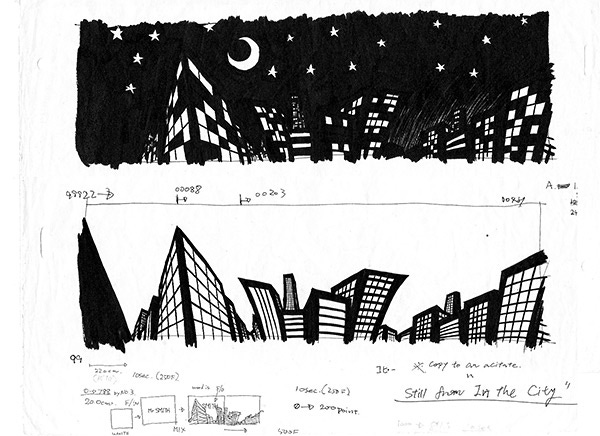
Kingston, 1997
In 1997, I was contacted by someone in the film department at Kingston University.
I studied music composition there.
They asked if I’d be interested in looking at a short animation by a Japanese student, and possibly submitting an idea for a soundtrack.
I said yes.
The Sketch
I watched the film (still a work in progress) and put something together.
It wasn’t finished. Just a sketch — one of a number of instrumental ideas I’d been working on at the time.
The animator, Yukihiro Tsujita, asked to meet.
He liked what I’d sent.
I explained that if I had the final animation, I could score it properly — syncing the piece to picture using Cubase and a QuickTime file, shaping it so it fitted exactly.
When the animation was finished — drawn entirely by hand — he sent it over.
I reworked the piece to fit.
Mr Smith
The film was called Mr Smith.
His department submitted it to a number of student awards.
It went on to win at least two, including a Royal Television Society Student Television Award for animation, with specific recognition for the soundtrack, and selection for the BAFTA Student Video Awards.
At the time, it didn’t feel like a defining moment.
Just one piece, among others.
Here is a video of Mr Smith I found on YouTube; the soundtrack quality on this upload is not great, so I have also included the only audio file I have of it in my archive, which is of slightly better quality.
Tokyo
About a year later, Yuki invited me to Japan.
Ten days or so in Tokyo.
I agreed.
Forty-eight hours before I was due to arrive, he called.
He’d been nominated for another award — in Canada — and had to leave immediately.
He apologised repeatedly, and told me he’d arranged for me to stay with his uncle, Mr Takeda, and his family.
I went anyway.
A real Mr Smith
I ended up spending nearly two weeks living with a Japanese family.
It didn’t take long to realise that Mr Takeda was, in many ways, a real-life version of Mr Smith.
Up early.
Breakfast at 5:30.
Out of the house by 6:30 for the commute into the city.
Long days. Six days a week. Then home — not to stop, but to continue.
Family. Responsibilities. The rhythm didn’t really break.
Seeing it up close gave the film a different weight. It wasn’t an idea. It was a pattern of life.
On the first day, I was served raw sea urchin at breakfast (at 05:30). I found it almost impossible to eat. But I did, politely, and said it was excellent. From that point on, it appeared every morning.
At one point, Mrs Takeda arranged a tea ceremony with several of her friends. They welcomed me warmly, and, at one stage, each of them apologised to me for the Second World War.
There were constant, subtle collisions between what I understood as politeness, and what it meant there.
My offering to pay my way, to contribute, to help, all normal elements of English social etiquette when a guest, well, all of it landed differently. A guest in a Japanese household doesn’t wash dishes or stock the fridge, or pay the restaurant bill, and attempting to do so could be viewed as insulting.
I had one friend in Tokyo, Satomi, a pianist with perfect pitch. I met her for lunch, maybe on the third day there. Thankfully, she briefed me on how to survive in the Takeda household. It was a way of life I hadn’t encountered before.
Around that time, Japan was going through a financial downturn.
In central Tokyo, I remember seeing men in business suits living in the railway station — quietly, almost invisibly.
I tried to take a photograph once, and was asked not to.
It was considered too much of a loss of face.
That stayed with me.
Afterwards
The instrumental album those sketches were part of was never completed.
Life moved on.
What remains are fragments.
Explorations across different approaches — including twelve-tone ideas and other compositional systems I was experimenting with at the time.
Most of it exists only as rough MIDI sketches, bounced quickly to MiniDisc.
The original sessions are long gone.
Mr Smith was one of the few pieces that stepped outside that.
The rest stayed where they were.
Until now.
The sketches are now available, as they are, on Bandcamp.
It’s all in a name
For those of you who like to delve, as a sound engineer and songwriter, I used more than one name, so for example (amongst others) Nic Briscoe, Nic Casparis, Nic Rudrum, Rudrum, U.NIK, and there were several Ting and Stuff’n’Ting remixes.
Are you at a point with a song or a musical project where moving forward means making an important decision, yet one you cannot quite pinpoint?
If you’re in that position — where the issue isn’t lack of ideas, but knowing what actually matters — that’s exactly the kind of work I do in my Musical Crossroads Sessions.

This is fantastic. That film and your score are even more relevant today! Amazing work.
Oh wow, Nic, that film and your music are so cool. I can see why it won awards. And what a story about your visit to Japan.
I hear you on the sea urchin. I went to one of those restaurants with pictures in the window and pointed to something because no one spoke English when I went (1983). Whatever I ordered was awful.